Now let's summarize the assumptions I am making:
China v USA
(i) Personal Consumption
durable goods 155%
non-durable goods 214%
(ii) Gross Private Domestic Investment
structures 13 times
equipment 13 times
intellectual property 80%
residential 13 times
(iii) Government Expenditure
defense investment 80%
state investment 13 times
All of the other items in the St Louis Fed calculation of US GDP are services of various types and one may well ask how do you compare these. For example the USA spends much more on healthcare than China but on the other hand care healthcare is much more expensive there also. How do you compare spending on education. For a sector such a transportation it would, in theory, be possible to determine passenger km per person per annum in the various modes of transportation. However for the purposes of this exercise I have decided to assume neutrality on services; i.e. I am assuming that the value is the same in real terms in China and the USA. We will thus compare the tangibles only.
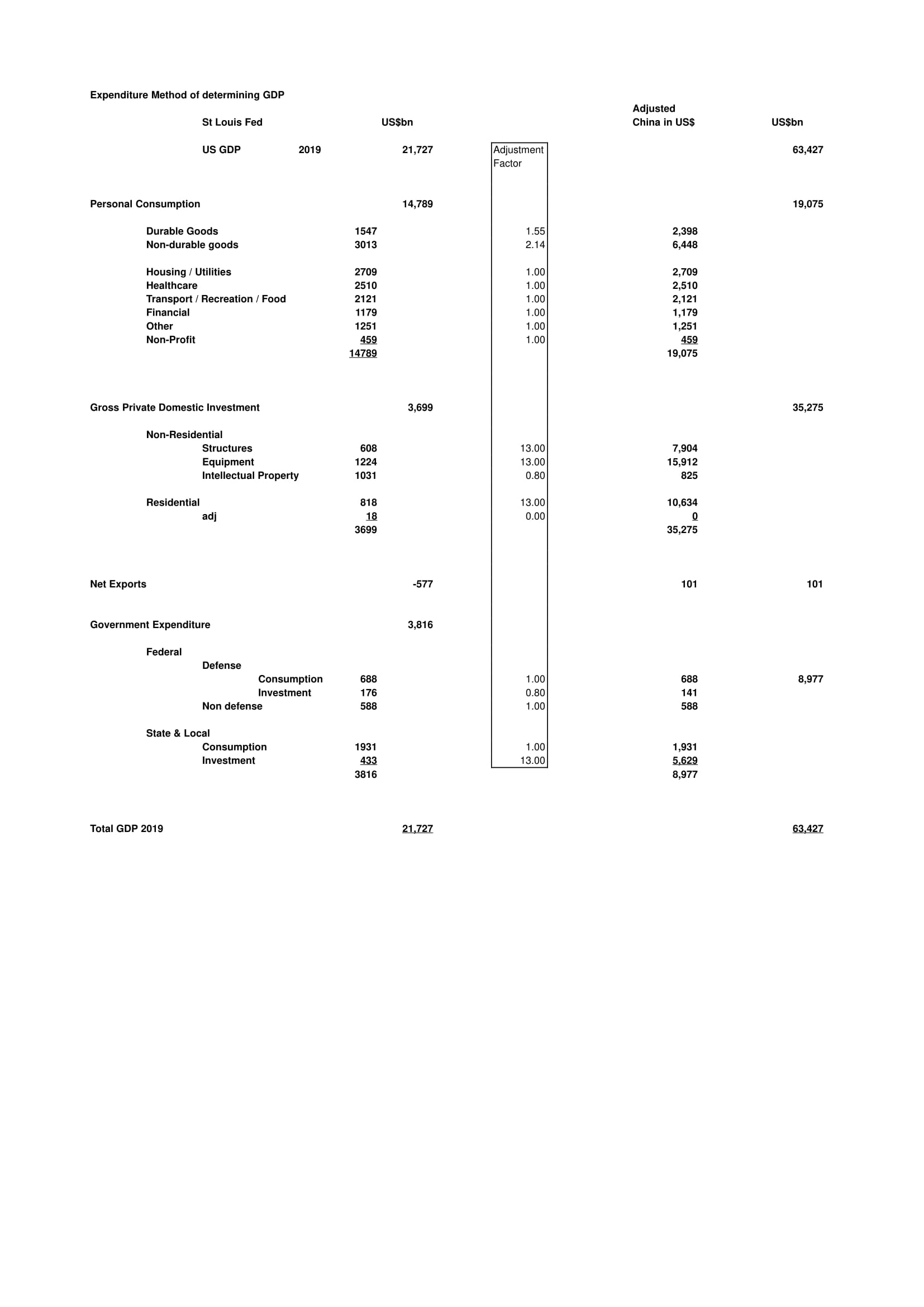
This gives us the table below. It can be seen that under this method China's GDP comes out about 3 times as large as the US. Under personal consumption the total comes out about 30% higher in China. This is fairly non-controversial since it is similar to the GDP differential on a PPP basis.
The big difference is on the investment side where the 13 times factoring has such a huge influence. Is this justified? Well where does all that steel go. And it's not just steel - for almost every mined commodity China is the most voracious consumer, often accounting for half the world total, and in many cases exceeding the next largest consumer by a factor of 10. The construction figure in China's official GDP appears to be understated by a factor of 4 compared with their own data for some reason. Furthermore the PPP calculations are focused on the consumer side and not the investment side and they therefore tend to undershoot on this phenomenon.
Another potential objection is that all of this building is worthless since it is State led and not market driven. It is thus more akin to investment in the ex Soviet Union. My reply to this objection would be to focus on the quality and the utilization rates of the infrastructure. In this regard are buildings being occupied, are roads filling up with cars and trucks, are trains filling up with passengers. It should be clear that in relation to rail infrastructure China is racing ahead of the rest of the world so this should negate any comparison with the Soviet Union.